What if we could restore aged cells to a younger state? What once sounded like science fiction is becoming increasingly plausible through advances in modern biomedical research. The desire to live as long as possible while maintaining good health has long since reached the public with the current longevity trend. While the focus is often on extending lifespan, research is increasingly addressing a different question: How can we preserve the body’s health and functionality well into old age and delay age-related diseases? [1] The aging process is a complex biological phenomenon shaped by the interplay of numerous cellular and molecular changes and is still not fully understood. Over the course of life, damage accumulates in cells and tissues as a result of various stress factors. At the same time, repair mechanisms and the body’s ability to maintain or regenerate damaged structures become altered. These changes contribute to an increased susceptibility to age-associated diseases [2].
Aging is therefore not only a matter of the number of years lived – it is above all a process involving profound changes at the cellular level. This is exactly where regenerative medicine aims to intervene. This relatively young field of research focuses on restoring and repairing damaged biological structures such as cells, tissues, bones, or organs [3]. A major milestone in regenerative medicine has been the field of stem cell research. Stem cell transplantation has already been successfully used for many years, for example in the treatment of certain disorders affecting the blood-forming system. At the same time, research has long faced challenges such as potential immune rejection and ethical debates surrounding embryonic stem cells.
1) iPSCs: A New Perspective on Cellular Aging and Regeneration
2) BPS Bioscience – Your Partner for iPSC-based Cell Models
3) Human iPSC-derived Cardiomyocytes
4) StemBright™ Reporter iPS Cells
5) Genetically Engineered iPSC Models for Functional Studies

iPSCs: A New Perspective on Cellular Aging and Regeneration
With the development of induced pluripotent stem cells (iPS cells or iPSCs), a new perspective emerged for stem cell research and regenerative medicine. Through the targeted reprogramming of mature somatic cells, these cells can be returned to a pluripotent state. In this state, they have the ability to differentiate again into various specialized cell types (Fig. 1). Reprogramming is triggered by the targeted activation of the transcription factors Oct4, Sox2, Klf4, and c-Myc, which are also known as the Yamanaka factors. Japanese stem cell researcher Shinya Yamanaka developed this reprogramming method in 2006 and was awarded the Nobel Prize in Physiology or Medicine in 2012 for this achievement [4,5].
iPS cells, however, offer not only great potential for regenerative applications – they also provide new insights into the mechanisms underlying aging and disease. By obtaining cells from healthy individuals or from people with specific diseases and genetic alterations, researchers can recreate and study disease processes in the laboratory. This enables the analysis of biological functions, disease-related changes, and potential therapeutic approaches in human cell models [4,6].
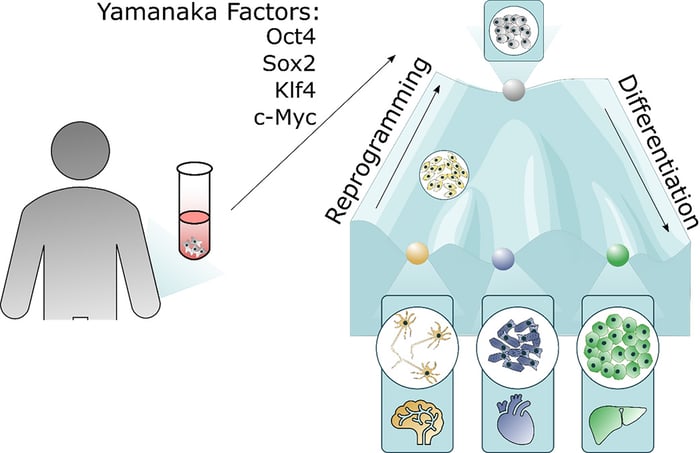 Figure 1: Reprogramming of somatic cells into induced pluripotent stem cells (iPSCs). Through the expression of the Yamanaka factors Oct4, Sox2, Klf4, and c-Myc, mature somatic cells can be reverted to a pluripotent state. The resulting iPSCs can then be differentiated into various specialized cell types, such as neurons, cardiomyocytes, or hepatocytes [7].
BPS Bioscience – Your Partner for iPSC-based Cell Models
To better understand aging processes and regenerative mechanisms, suitable human cell models are essential. Our partner BPS Bioscience supports a wide range of research applications by providing iPS cells, iPSC-derived cell types, as well as genetically engineered iPSC-based reporter and knockout models. Compared to conventional cell lines, iPSC-derived cell models can more closely reflect physiologically relevant conditions, as they retain characteristics of specialized human cells. This opens up new possibilities for studying cell functions, disease mechanisms, drug development, and future cell therapy approaches [5].

Human iPSC-derived Cardiomyocytes
Human cardiomyocytes differentiated from iPS cells enable the study of cardiac functions under physiologically relevant conditions. These functional heart muscle cells can, for example, be used to investigate age-associated changes in cardiac biology or to evaluate potential drug candidates regarding their effects and safety.
| Cells | Product Number | Amount |
| Human iPSC Derived Cardiomyocytes | BPS-78529 | 1 Million Cells 5 Million Cells |
| Human B2M Knockout iPSC Derived Cardiomyocytes | BPS-82541 | 1 Vial |
StemBright™ Reporter iPS Cells
In addition to specialized cell types, reporter iPS cells enable the targeted investigation of cellular signaling pathways. Integrated reporter systems allow changes in biological processes to be measured – for example, during cell differentiation, in response to cellular stress, or within aging-related signaling pathways. One example is the Wnt signaling pathway, which plays a role in developmental processes and the regulation of cellular functions.
| Cells | Product Number | Amount |
| StemBright™ Luciferase iPS Cell Pool | BPS-78594 | 1 Vial |
| TCF/LEF StemBright™ Luciferase iPS Cell Pool (Wnt Pathway) | BPS-78515 | 2 Vials |
Genetically Engineered iPSC Models for Functional Studies
To investigate the influence of individual genes or proteins on cellular functions, genetically modified iPSC models provide additional research opportunities. Using CRISPR/Cas9 technology, targeted genetic modifications can be introduced to better understand disease mechanisms or regenerative processes. Cas9-expressing iPS cells enable controlled genetic modification, while knockout iPS cells can be used to study the function of specific target proteins.
| Cells | Product Number | Amount |
| Cas9 Expressing iPS Cell Pool | BPS-78578 | 1 Vial |
| Transduction Control (EF1A Promoter) iPS Cell Pool | BPS-82520 | 2 Vials |
| Cas9 Inducible (Tet-On) iPS Cell Pool | BPS-78845 | 1 Vial |
| Transduction Control (Tet-On) iPS Cell Pool | BPS-82289 | 2 Vials |
| B2M Knockout iPS Cell Line | BPS-82161 | 1 Vial |
The development of induced pluripotent stem cells has created new opportunities to study human aging processes, diseases, and potential therapeutic approaches directly in relevant cell models. Due to their versatile differentiation capabilities, iPS cells provide valuable insights into cellular mechanisms and represent an important foundation for research in regenerative approaches.
Discover the iPSC-based research models from BPS Bioscience and advance your research with innovative cell models.
Sources
[1] https://de.wikipedia.org/wiki/Longevity, 14.06.2026
[2] Yu, P.; Liu, B.; Dong, C.; Chang, Y. Induced Pluripotent Stem Cells-Based Regenerative Therapies in Treating Human Aging-Related Functional Decline and Diseases. Cells 2025, 14, 619.
[3] https://flexikon.doccheck.com/de/Regenerative_Medizin, 14.06.2026
[4] https://de.wikipedia.org/wiki/Induzierte_pluripotente_Stammzelle, 14.06.2026
[5] https://bpsbioscience.com/ipsc-derived-cells?product_type_filter=&target_field=&research_areas=7718&cell_line_type=&species_filter=, 14.06.2026
[6] https://bpsbioscience.com/research-applications-for-engineered-ips-cells, 14.06.2026
[7] https://bpsbioscience.com/propel-your-research-forward-with-ips-cells, 14.06.2026
Preview Image: https://bpsbioscience.com/innovative-tools-driving-progress-in-neuroscience-research