---
title: How Do Antibiotics Affect Cell Wall Synthesis?
description: Certain antibiotics interfere with various aspects of the synthesis of the peptidoglycan cell wall. What are the basic molecular mechanisms?
image: https://resources.biomol.com/hubfs/Imported_Blog_Media/How-Do-Antibiotics-Work-Apr-07-2025-06-38-09-3288-PM.png
---
en
EN DE
[** My account ](https://www.biomol.com/account)
** Service/Help
- [Contact](https://www.biomol.com/contact)
- [Technical Service](https://www.biomol.com/technical-service)
- [FAQ](https://www.biomol.com/faq)
- [Shipping Costs](https://www.biomol.com/shipping-costs)
- [Product Search Tips](https://www.biomol.com/product-search-tips)
- [Distributors](https://www.biomol.com/distributors)
- [Company History](https://www.biomol.com/company-history)
- Cookie Settings
- [** Menu ](https://resources.biomol.com/biomol-blog/how-do-antibiotics-affect-cell-wall-synthesis#offcanvas--left)
- [**Search Tips ](https://www.biomol.com/product-search-tips)
- [** Search ](https://resources.biomol.com/biomol-blog/how-do-antibiotics-affect-cell-wall-synthesis#show-hide--search)
** Search
- [** ](https://www.biomol.com/product-search-tips)
- [** My account ](https://www.biomol.com/account)
- [Products ](https://www.biomol.com/products/)
- [Suppliers ](https://www.biomol.com/suppliers/)
- [Resources ](https://www.biomol.com/resources/)
- [Promotions ](https://www.biomol.com/promotions/)
- [About Biomol ](https://www.biomol.com/about-biomol/)
- [** My account ](https://www.biomol.com/account)
[** To category Products ](https://www.biomol.com/products/) **
- [Antibodies](https://www.biomol.com/products/antibodies/)
- [Primary Antibodies](https://www.biomol.com/products/antibodies/primary-antibodies/)
- [Secondary Antibodies](https://www.biomol.com/products/antibodies/secondary-antibodies/)
- [Igs and Isotype Controls](https://www.biomol.com/products/antibodies/igs-and-isotype-controls/)
- [Antibody Panels](https://www.biomol.com/products/antibodies/antibody-panels/)
- [Assay Kits](https://www.biomol.com/products/assay-kits/)
- [ELISA and Immunoassays](https://www.biomol.com/products/assay-kits/elisa-and-immunoassays/)
- [Biochemical Assays](https://www.biomol.com/products/assay-kits/biochemical-assays/)
- [Cell-Based Assays](https://www.biomol.com/products/assay-kits/cell-based-assays/)
- [Biological Samples](https://www.biomol.com/products/biological-samples/)
- [Cells](https://www.biomol.com/products/biological-samples/cells/)
- [Virus-based Tools](https://www.biomol.com/products/biological-samples/virus-based-tools/)
- [Lysates](https://www.biomol.com/products/biological-samples/lysates/)
- [Nucleic Acids](https://www.biomol.com/products/biological-samples/nucleic-acids/)
- [Blood Products](https://www.biomol.com/products/biological-samples/blood-products/)
- [Tissues](https://www.biomol.com/products/biological-samples/tissues/)
- [Other](https://www.biomol.com/products/biological-samples/other/)
- [Chemicals](https://www.biomol.com/products/chemicals/)
- [Biochemicals](https://www.biomol.com/products/chemicals/biochemicals/)
- [Lipids](https://www.biomol.com/products/chemicals/lipids/)
- [Reference Standards](https://www.biomol.com/products/chemicals/reference-standards/)
- [Dyes and Labeling Reagents](https://www.biomol.com/products/chemicals/dyes-and-labeling-reagents/)
- [Antibiotics](https://www.biomol.com/products/chemicals/antibiotics/)
- [Biological Buffers](https://www.biomol.com/products/chemicals/biological-buffers/)
- [Detergents](https://www.biomol.com/products/chemicals/detergents/)
- [CpG ODNs](https://www.biomol.com/products/chemicals/cpg-odns/)
- [Screening Libraries](https://www.biomol.com/products/chemicals/screening-libraries/)
- [Plasmids](https://www.biomol.com/products/plasmids/)
- [cDNA Clones](https://www.biomol.com/products/plasmids/cdna-clones/)
- [Other](https://www.biomol.com/products/plasmids/other/)
- [Primers](https://www.biomol.com/products/primers/)
- [qPCR Gene Primers](https://www.biomol.com/products/primers/qpcr-gene-primers/)
- [qPCR Gene Family Primers](https://www.biomol.com/products/primers/qpcr-gene-family-primers/)
- [qPCR Control Gene Primers](https://www.biomol.com/products/primers/qpcr-control-gene-primers/)
- [qPCR Primer Libraries](https://www.biomol.com/products/primers/qpcr-primer-libraries/)
- [Proteins and Peptides](https://www.biomol.com/products/proteins-and-peptides/)
- [Proteins](https://www.biomol.com/products/proteins-and-peptides/proteins/)
- [Cytokines](https://www.biomol.com/products/proteins-and-peptides/cytokines/)
- [Peptides](https://www.biomol.com/products/proteins-and-peptides/peptides/)
- [Toolkits](https://www.biomol.com/products/toolkits/)
- [Kit Components](https://www.biomol.com/products/toolkits/kit-components/)
- [Conjugation Kits](https://www.biomol.com/products/toolkits/conjugation-kits/)
- [Sample Prep Kits](https://www.biomol.com/products/toolkits/sample-prep-kits/)
- [Cloning and Expression Kits](https://www.biomol.com/products/toolkits/cloning-and-expression-kits/)
- [Mutagenesis Kits](https://www.biomol.com/products/toolkits/mutagenesis-kits/)
- [Sequencing Kits](https://www.biomol.com/products/toolkits/sequencing-kits/)
- [Accessory Reagents](https://www.biomol.com/products/accessory-reagents/)
- [Staining Solutions](https://www.biomol.com/products/accessory-reagents/staining-solutions/)
- [Cell Culture Media](https://www.biomol.com/products/accessory-reagents/cell-culture-media/)
- [Agaroses](https://www.biomol.com/products/accessory-reagents/agaroses/)
- [Stabilizers](https://www.biomol.com/products/accessory-reagents/stabilizers/)
- [Protein Markers](https://www.biomol.com/products/accessory-reagents/protein-markers/)
- [DNA Ladders](https://www.biomol.com/products/accessory-reagents/dna-ladders/)
- [Transfection Reagents](https://www.biomol.com/products/accessory-reagents/transfection-reagents/)
[** To category Products ](https://www.biomol.com/products/) **
- [AAT Bioquest](https://www.biomol.com/aat-bioquest/)
- [Abcore](https://www.biomol.com/abcore/)
- [Absea](https://www.biomol.com/absea/)
- [Acepix Biosciences](https://www.biomol.com/acepix/)
- [AdipoGen Life Sciences](https://www.biomol.com/adipogen/)
- [Akadeum Life Sciences](https://www.biomol.com/akadeum-life-sciences/)
- [Alithea Genomics](https://www.biomol.com/alithea-genomics/)
- [Amsbio](https://www.biomol.com/amsbio/)
- [Ancell](https://www.biomol.com/ancell/)
- [Arigo Biolaboratories](https://www.biomol.com/arigo/)
- [Assay Genie](https://www.biomol.com/assay-genie/)
- [AssayQuant](https://www.biomol.com/assayquant/)
- [Atlas Antibodies](https://www.biomol.com/atlas-antibodies/)
- [Badische Peptide & Proteine](https://www.biomol.com/bpp/)
- [Bertin Bioreagent](https://www.biomol.com/bertin-bioreagent/)
- [Bethyl Laboratories](https://www.biomol.com/bethyl/)
- [Biomol GmbH](https://www.biomol.com/biomol-gmbh/)
- [Biotium](https://www.biomol.com/biotium/)
- [BPS Bioscience](https://www.biomol.com/bps/)
- [Cavidi](https://www.biomol.com/cavidi/)
- [Cayman Chemical](https://www.biomol.com/cayman/)
- [Chemodex](https://www.biomol.com/chemodex/)
- [Chimerigen Laboratories](https://www.biomol.com/chimerigen/)
- [Croyez](https://www.biomol.com/croyez/)
- [Cusabio](https://www.biomol.com/cusabio/)
- [Cytion](https://www.biomol.com/cytion/)
- [Diaclone](https://www.biomol.com/diaclone/)
- [DIMA Biotech](https://www.biomol.com/dima/)
- [Elabscience](https://www.biomol.com/elabscience/)
- [ELK Biotechnology](https://www.biomol.com/elk-biotechnology/)
- [Expert Synthesis Solutions](https://www.biomol.com/ess/)
- [ForMedium](https://www.biomol.com/formedium/)
- [GenScript](https://www.biomol.com/genscript/)
- [Hycult Biotech](https://www.biomol.com/hycult-biotech/)
- [ImmunoChemistry](https://www.biomol.com/ict/)
- [Indigo Biosciences](https://www.biomol.com/indigo/)
- [Innaxon](https://www.biomol.com/innaxon/)
- [InVitria](https://www.biomol.com/invitria/)
- [IsoSciences](https://www.biomol.com/isosciences/)
- [JaICA](https://www.biomol.com/jaica/)
- [KACTUS](https://www.biomol.com/kactus/)
- [Kingfisher Biotech](https://www.biomol.com/kingfisher/)
- [LKT Laboratories](https://www.biomol.com/lkt/)
- [LubioScience](https://www.biomol.com/lubioscience/)
- [Micronbrane Medical](https://www.biomol.com/micronbrane/)
- [MONOSAN](https://www.biomol.com/monosan/)
- [nanoComposix](https://www.biomol.com/nanocomposix/)
- [Navinci Diagnostics](https://www.biomol.com/navinci/)
- [NeoBiotechnologies](https://www.biomol.com/neobiotechnologies/)
- [NewEast Biosciences](https://www.biomol.com/neweastbio/)
- [Novoprotein](https://www.biomol.com/novoprotein/)
- [NSJ Bioreagents](https://www.biomol.com/nsjbio/)
- [NuSep](https://www.biomol.com/nusep/)
- [NZYtech](https://www.biomol.com/nzytech/)
- [ORF Genetics](https://www.biomol.com/orf-genetics/)
- [Pacific Coast Bio](https://www.biomol.com/pacific-coast-bio/)
- [Peptides & Elephants](https://www.biomol.com/peptides-and-elephants/)
- [Quantoom Biosciences](https://www.biomol.com/quantoom/)
- [Randox](https://www.biomol.com/randox/)
- [RealTimePrimers](https://www.biomol.com/realtimeprimers/)
- [Research Donors](https://www.biomol.com/research-donors/)
- [RevMAb Biosciences](https://www.biomol.com/revmab/)
- [Rockland Immunochemicals](https://www.biomol.com/rockland/)
- [Slingshot Biosciences](https://www.biomol.com/slingshot/)
- [South Bay Bio](https://www.biomol.com/south-bay-bio/)
- [SYNkinase](https://www.biomol.com/synkinase/)
- [TargetMol](https://www.biomol.com/targetmol/)
- [U-genes](https://www.biomol.com/u-genes/)
- [United States Biological](https://www.biomol.com/usbiological/)
- [Virax Biolabs](https://www.biomol.com/virax-biolabs/)
[** To category Products ](https://www.biomol.com/products/) **
- [Biomol Blog](https://resources.biomol.com/biomol-blog)
- [Applications](https://www.biomol.com/resources/applications/)
- [Webinars](https://www.biomol.com/resources/webinars/bps-bioscience/)
- [Protocols](https://www.biomol.com/resources/protocols/)
- [Buffer Recipes](https://www.biomol.com/resources/buffer-recipes/)
- [Catalogs](https://www.biomol.com/resources/catalogs/)
- [Wall Posters](https://www.biomol.com/resources/wall-posters/)
- [Conference Calendar](https://www.biomol.com/resources/conference-calendar/)
- [Newsletter](https://www.biomol.com/newsletter)
- [Tools](https://www.biomol.com/resources/tools/molarity-calculator/)
- [Molarity Calculator](https://www.biomol.com/resources/tools/molarity-calculator/)
- [Cytokine Activity Conversion](https://www.biomol.com/resources/tools/cytokine-activity-conversion/)
- [ELISA Analysis](https://www.biomol.com/resources/tools/elisa-analysis/)
- [Fluorescence Spectrum Viewer](https://www.biomol.com/resources/tools/fluorescence-spectrum-viewer/)
Resources
Download detailed protocols and guides for different applications. Get the latest catalogs and brochures from our partners and learn where you can meet us in person at conferences. Learn more about our products in our blog and use online tools to... [ learn more ](https://www.biomol.com/resources/)
[** To category Products ](https://www.biomol.com/products/) **
- [Company History](https://www.biomol.com/company-history)
- [Awards](https://www.biomol.com/awards)
- [Contact](https://www.biomol.com/contact-form)
- [Technical Support](https://www.biomol.com/technical-service)
- [Career](https://www.biomol.com/job-offers)
- [FAQ](https://support.biomol.com/?hsLang=en)
- [ Close menu ** ](https://resources.biomol.com/biomol-blog/how-do-antibiotics-affect-cell-wall-synthesis#close-categories-menu)
en
DE
Categories
- [Products](https://www.biomol.com/products/)
- [Suppliers](https://www.biomol.com/suppliers/)
- [Resources](https://www.biomol.com/resources/)
- [Promotions](https://www.biomol.com/promotions/)
- [About Biomol](https://www.biomol.com/about-biomol/)
Information
- [Contact](https://www.biomol.com/contact)
- [Technical Service](https://www.biomol.com/technical-service)
- [FAQ](https://www.biomol.com/faq)
- [Shipping Costs](https://www.biomol.com/shipping-costs)
- [Product Search Tips](https://www.biomol.com/product-search-tips)
- [Distributors](https://www.biomol.com/distributors)
- [Company History](https://www.biomol.com/company-history)
- Cookie Settings
- [Home](https://www.biomol.com/)
- [Blog](https://resources.biomol.com/biomol-blog)
- How Do Antibiotics Affect Cell Wall Synthesis?
- [Antibiotics](https://resources.biomol.com/biomol-blog/tag/antibiotics)
- [Cayman Chemical](https://resources.biomol.com/biomol-blog/tag/cayman-chemical)
# How Do Antibiotics Affect Cell Wall Synthesis?
Written by: Dr. Balint Földesi 04-25-2021
Share post on social media:
[Share on Whatsapp ](whatsapp://send?text=https://resources.biomol.com/biomol-blog/how-do-antibiotics-affect-cell-wall-synthesis) [Share on X ](https://twitter.com/intent/tweet?source=https://resources.biomol.com/biomol-blog/how-do-antibiotics-affect-cell-wall-synthesis&text=How%20Do%20Antibiotics%20Affect%20Cell%20Wall%20Synthesis?%20-%20https://resources.biomol.com/biomol-blog/how-do-antibiotics-affect-cell-wall-synthesis) [Share on LinkedIn ](https://www.linkedin.com/shareArticle?mini=true&url=https://resources.biomol.com/biomol-blog/how-do-antibiotics-affect-cell-wall-synthesis) [Share on Facebook ](https://www.facebook.com/sharer/sharer.php?u=https://resources.biomol.com/biomol-blog/how-do-antibiotics-affect-cell-wall-synthesis)
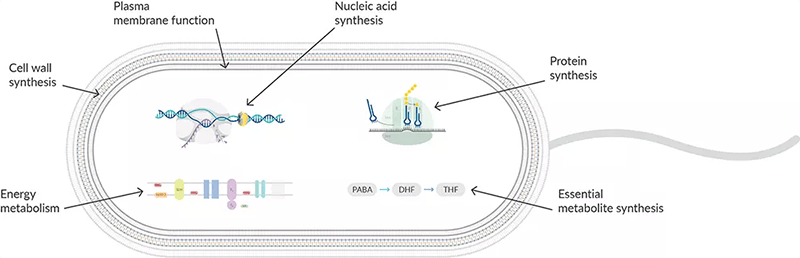
β-Lactam antibiotics, including penicillins, [cephalosporins](https://www.biomol.com/cephalosporins), [monobactams](https://www.biomol.com/monobactams), and [carbapenems](https://www.biomol.com/carbapenems), are distinguished by a lactam ring in their molecular structure and act by inhibiting the synthesis of the peptidoglycan layer of bacterial cell walls. They interfere with the transpeptidase, transglycosylase, and/or carboxypeptidase activities of species-specific membrane-bound penicillin-binding proteins (PBPs) that facilitate cross-linking of the cell wall components during the final stage of bacterial cell wall synthesis (**Figure 1**). This occurs by binding to the terminal D-Ala-D-Ala in the lengthening peptidoglycan structure and rapidly acylating the active site serine of the PBP, followed by very slow deacylation, which inactivates the PBP. As the cell grows, it is not able to synthesize more cell wall to accommodate the expansion. As a result, the pressure inside the cell will push the plasma membrane out of a weak spot in the cell wall like a balloon, which will eventually rupture. Because the formation of a division furrow to create new daughter cells depends on the ability to synthesize a new cell wall, the cell is unable to pinch off the extra cytoplasmic material. An extremely vulnerable spheroplast is formed when the cell wall sheds entirely. In this form, bacteria lose control over their shape, and the duplication of much of their genetic and metabolic material further disrupts homeostasis, which leads to cell death.
Bacteria develop resistance to β-lactam antibiotics by synthesizing β-lactamase, an enzyme that attacks the β-lactam ring to inactivate the antibiotic. More than 1,000 unique β-lactamases have been described. To overcome this resistance, β-lactam antibiotics are usually given with β-lactamase inhibitors. Efflux and modification or deletion of porin function can also play a role in resistance to some β-lactams in conjunction with β-lactamase production, which results in resistance to virtually all β-lactams. Some bacteria area also able to acquire new PBPs that have low affinity for β-lactams. The best-known example of this strategy for resistance occurs with methicillin-resistant *S. aureus* (MRSA) that evolved a PBP with low affinity for all but a few recently developed β-lactams.
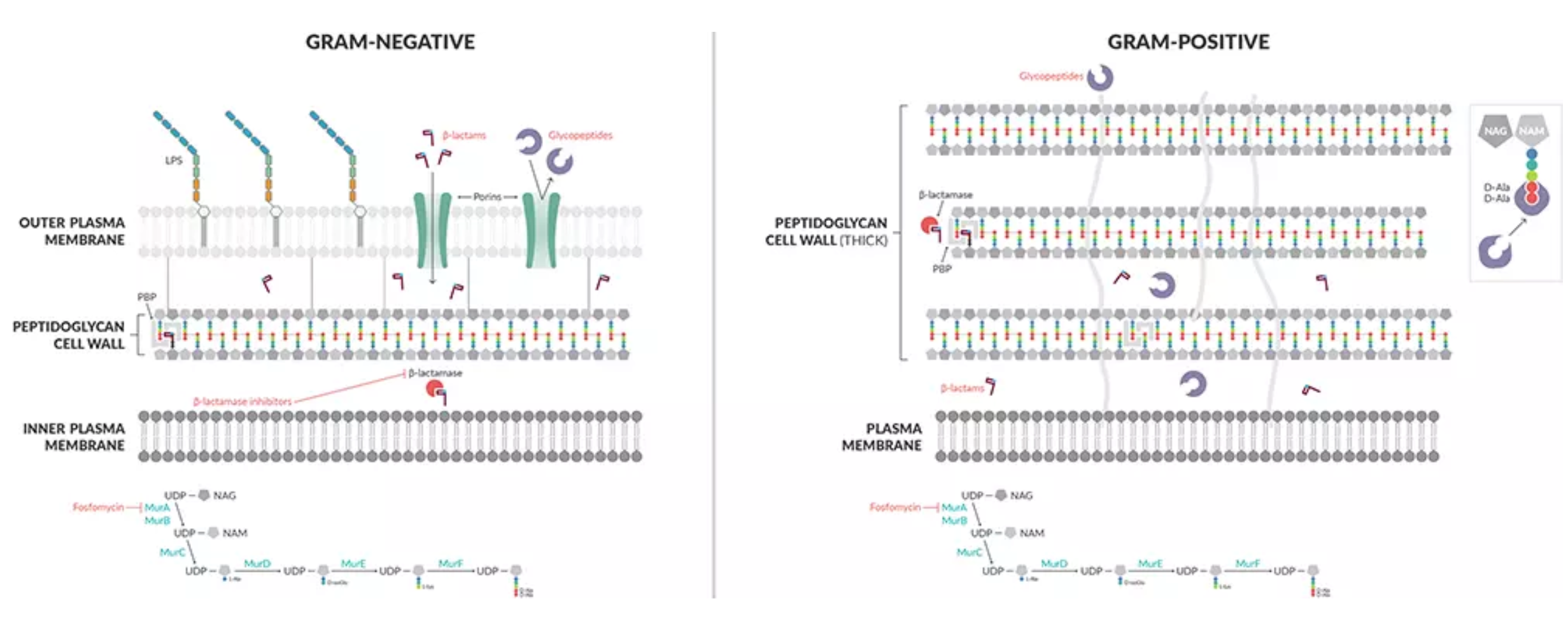
**Figure 1**: Antibiotics interfere with various aspects of the synthesis of the peptidoglycan cell wall. Gram-negative cell walls consist of two layers external to the cell membrane—a thin layer of peptidoglycan and an outer membrane with porins that allow certain antibiotics but not glycopeptides to diffuse through to their site of action. Gram-positive bacteria have a thicker peptidoglycan layer but lack an extra outer membrane enabling glycopeptide access.
[Glycopeptides and lipoglycopeptides](https://www.biomol.com/glycopeptides) are composed of glycosylated cyclic or polycyclic nonribosomal peptides that interfere with cell wall formation by forming a complex between the antibiotic and the C-terminal D-Ala-D-Ala dipeptide of the nascent peptidoglycan on the outer surface of the cell membrane of Gram-positive bacteria (**Figure 1**). The formation of this complex prevents the transglycosylation and transpeptidation reactions that are necessary for completion of the peptidoglycan chain, resulting in an incomplete cell wall and subsequent cell death. They are too bulky to pass through the porin channels found in the outer membrane of Gram-negative bacteria. In addition to its interaction with D-Ala-D-Ala, some antibiotics in this group bind to lipid II, a cell wall precursor on the cytoplasmic side of the cell membrane that must translocate across the cell membrane to deliver and incorporate its disaccharide-pentapeptide monomer for cross-linking into peptidoglycan. This interaction results in membrane depolarization and eventual membrane disruption that leads to cell death. Since glycopeptides target the outer surface of the cell wall, they do not have to overcome a membrane barrier and do not interact with enzymes. Known glycopeptide resistance mechanisms instead are associated with structural modifications in the substrates for the enzymes that incorporate the final amino acids in the pentapeptide precursors. The most relevant modifications involve replacement of the C-terminal D-Ala with D-lactate or D-serine, resulting in D-Ala-D-Lac or D-Ala-D-Ser peptide sequences with reduced binding affinities for the antibiotic.
The phosphonic acid [fosfomycin](https://www.biomol.com/products/chemicals/antibiotics/fosfomycin-trometamol-cay23632-5) inhibits the growth of a wide variety of bacteria by targeting the enolpyruvyl transferase MurA, which catalyzes the first committed step of peptidoglycan synthesis that is essential for cell wall formation (**Figure 1**). It enters cells through glycerol-3-phosphate and hexose-6-phosphate transporters. Deficiency in these transporters that cause increased efflux or decreased cellular uptake can lead to resistance. Specific murA gene mutations that produce an enzyme with reduced affinity for fosfomycin or increased expression of MurA that overwhelms the capacity of fosfomycin for growth inhibition are also known causes of resistance. Fosfomycin-inactivating enzymes have also been documented.
[List Antibiotics](https://www.biomol.com/products/chemicals/antibiotics/)
## You might also like...
SEE MORE BLOGPOST
##### How Do Antibiotics Affect Plasma Membrane Function?
Disrupting the plasma membrane causes rapid depolarization, resulting in a loss of membrane potential leading to inhibition of protein, DNA...
- [Antibiotics](https://resources.biomol.com/biomol-blog/tag/antibiotics)
- [Cayman Chemical](https://resources.biomol.com/biomol-blog/tag/cayman-chemical)
##### How Do Antibiotics Work?
As one of the most highly exploited medication classes, antibiotics address a broad range of bacterial infections by either killing...
- [Antibiotics](https://resources.biomol.com/biomol-blog/tag/antibiotics)
- [Cayman Chemical](https://resources.biomol.com/biomol-blog/tag/cayman-chemical)

##### How Do Antibiotics Affect Nucleic Acid Synthesis?
Antibiotics that target RNA transcription or DNA replication to prevent new bacteria from being produced must be able to easily diffuse...
- [Antibiotics](https://resources.biomol.com/biomol-blog/tag/antibiotics)
- [Cayman Chemical](https://resources.biomol.com/biomol-blog/tag/cayman-chemical)
Biomol Newsletter
Subscribe to the free Biomol newsletter and receive updates on research tools from Biomol. You will also receive a **10€ Voucher** for your next order.
Click here to subscribe to our newsletter! **
Important Notice
Please note that our products are for **research use only** and **cannot be delivered to private individuals** and addresses, but only to authorized institutions and businesses.
You can find us on
[** ](https://www.facebook.com/biomol) [** ](https://www.linkedin.com/company/biomol-gmbh/) [** ](https://www.xing.com/companies/biomolgmbh) [** ](https://www.youtube.com/channel/UCRD-h8vgRJc2p83-y_ITJDA) [ ](https://mastodon.social/@biomol)
Legal
- [ Privacy Policy ](https://www.biomol.com/privacy-policy)
- Cookie Settings
- [ Trademarks ](https://www.biomol.com/trademarks)
- [ Terms and Conditions ](https://www.biomol.com/terms-and-conditions)
- [ Imprint ](https://www.biomol.com/imprint)
About Biomol
- [ Contact ](https://www.biomol.com/contact)
- [ Technical Service ](https://www.biomol.com/technical-service)
- [ FAQ ](https://www.biomol.com/faq)
- [ Shipping Costs ](https://www.biomol.com/shipping-costs)
- [ Product Search Tips ](https://www.biomol.com/product-search-tips)
- [ Distributors ](https://www.biomol.com/distributors)
- [ Company History ](https://www.biomol.com/company-history)
- [ Memberships ](https://www.biomol.com/memberships)
- [ Job Offers ](https://www.biomol.com/job-offers)
- [ Sitemap ](https://www.biomol.com/sitemap)
Customer Service
Mon - Thu, 9 am - 5 pm CET
Fri, 9 am - 4 pm CET
Tel: [+49-40-8532600](tel:+49-40-8532600)
Email: [info@biomol.com](mailto:info@biomol.com)
Awards
[ ](https://www.biomol.com/awards)
Payment Methods

Shipping
 We ship with UPS Express Saver.
**Free** [shipping and coolant](https://www.biomol.com/shipping-costs) for online orders over 1,000 € within Germany *(does not apply when shipping fresh blood products from [Research Donors](https://www.biomol.com/research-donors/))*.
[** ](https://www.facebook.com/biomol) [** ](https://www.linkedin.com/company/biomol-gmbh/) [** ](https://www.xing.com/companies/biomolgmbh) [** ](https://www.youtube.com/channel/UCRD-h8vgRJc2p83-y_ITJDA) [ ](https://mastodon.social/@biomol)
© 2025 Biomol GmbH - Life Science Shop | Kieler Straße 303a | 22525 Hamburg | Germany
```json
{
"@context" : "https://schema.org",
"@type" : "BlogPosting",
"author" : {
"@type" : "Person",
"name" : "Dr. Balint Földesi",
"url" : "https://resources.biomol.com/biomol-blog/author/dr-balint-földesi"
},
"dateModified" : "2025-04-07T18:38:39.075Z",
"datePublished" : "2021-04-25T22:00:00.000Z",
"headline" : "How Do Antibiotics Affect Cell Wall Synthesis?",
"image" : [ "https://resources.biomol.com/hubfs/Imported_Blog_Media/How-Do-Antibiotics-Work-Apr-07-2025-06-38-09-3288-PM.png" ],
"mainEntityOfPage" : {
"@id" : "https://resources.biomol.com/biomol-blog/how-do-antibiotics-affect-cell-wall-synthesis",
"@type" : "WebPage"
},
"publisher" : {
"@type" : "Organization",
"logo" : {
"@type" : "ImageObject",
"url" : "https://resources.biomol.com/hubfs/Biomol/biomol-logo.png"
}
}
}
```